

Coming out of winter
There's one morning, every year, when I feel it before I've even opened the shutters. The light has changed. It comes in earlier, softer, and slides over the granite of the low walls differently from the week before. The snow, by now, clings only to the shaded hollows, where the sun has yet to reach. And then there are the birds — that little morning racket that gradually returns, as if someone had switched the radio back on in the next room.
Here, at La Domerie, on the Aubrac plateau, spring isn't decreed by the calendar. It's sensed. At over 1,200 metres of altitude, winter lingers, and the slightest mild spell stays suspect until you've seen the first daffodil flower. It's not unusual for a last snowfall to dust the meadows when spring is, on paper, already well established. That's exactly what makes its arrival so moving: everything is hard-won.
I'd like to tell you about it. How spring is born here, around the house. Not the spring of the almanacs — ours, the one that rises from the still-cold ground and bursts, in just a few weeks, into an ocean of flowers.
The flowering calendar
The loveliest thing about the Aubrac is that the flowering reads like a musical score. Each thing in its time, in an order that never deceives.
It begins softly, at winter's end. From late February and into March, as the days lengthen, the undergrowth becomes dotted with little white and purple flowers, and a few anemones venture out among the dead leaves. Nothing spectacular yet — scattered touches, promises, the tender green returning to the buds.
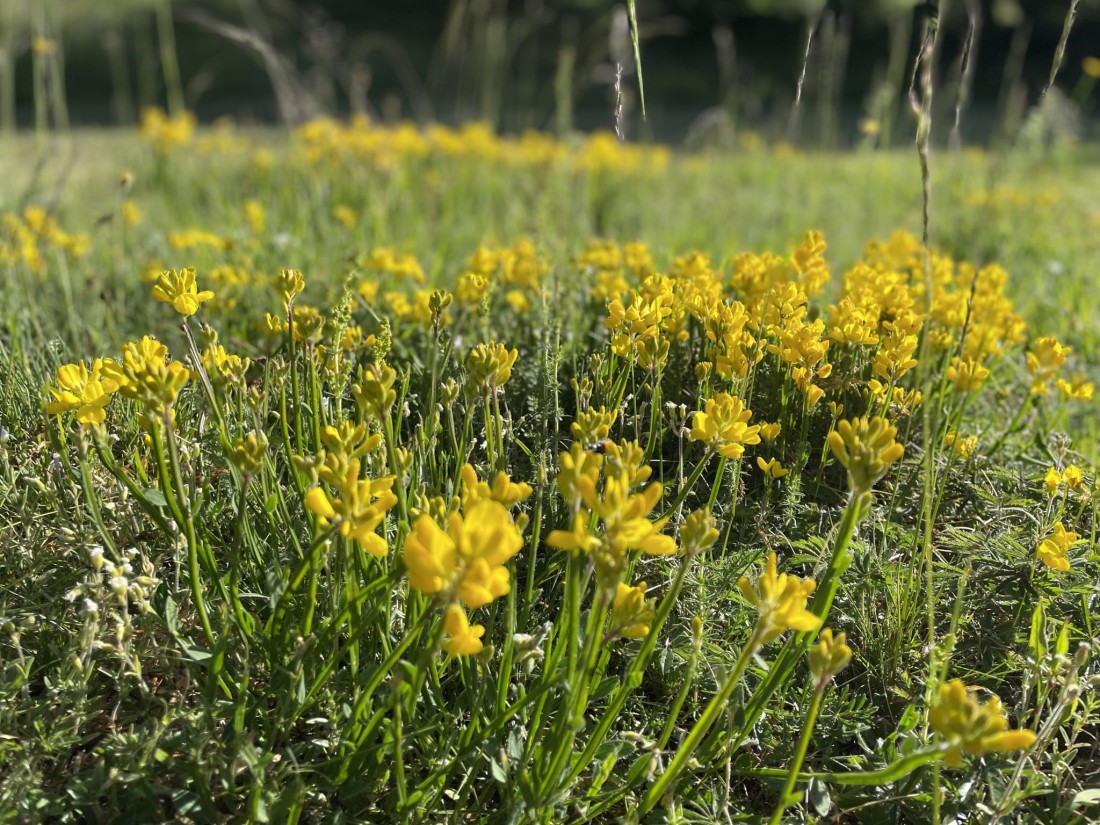
Then comes the great yellow. When April arrives, the meadows slowly turn to gold: the daffodils, in their thousands, colonising the slopes and carpeting the summer pastures as far as the eye can see. The display is as sudden as it is fleeting — a few days early or late are enough to change everything from one year to the next.
And finally, the grand finale: the narcissi. Nicknamed the plateau's "white gold," they generally reach their peak in May, turning the Aubrac into a vast white sea flecked with yellow.
A word of honesty, all the same, for anyone thinking of coming specially. Nature signs no contracts. Depending on how mild the season is, the narcissi may open in the first days of May — and if the heat comes too quickly, their bloom sometimes lasts no more than a handful of days. So my best advice: don't bet on a precise date, come with an open mind, and let chance do the picking.
Portraits of flowers, around the house
The daffodils
They're the first I meet on my way out. A few steps along the path that leaves from the house and already they're there, by the handful, in the sloping meadows. A bold, almost brazen yellow, set against the green still heavy with water. No need to go far to admire them: just head up toward the north of the plateau, where they happily settle in from early spring.
The narcissi
Ah, the narcissi. If I had to keep just one, it would be this. Slender petals of immaculate white, gathered around a small yellow crown at the centre — the shape of a tiny star, sown endlessly across the meadows. And above all that scent, which drifts just above the grass on mild May evenings and which you never forget once you've breathed it in.
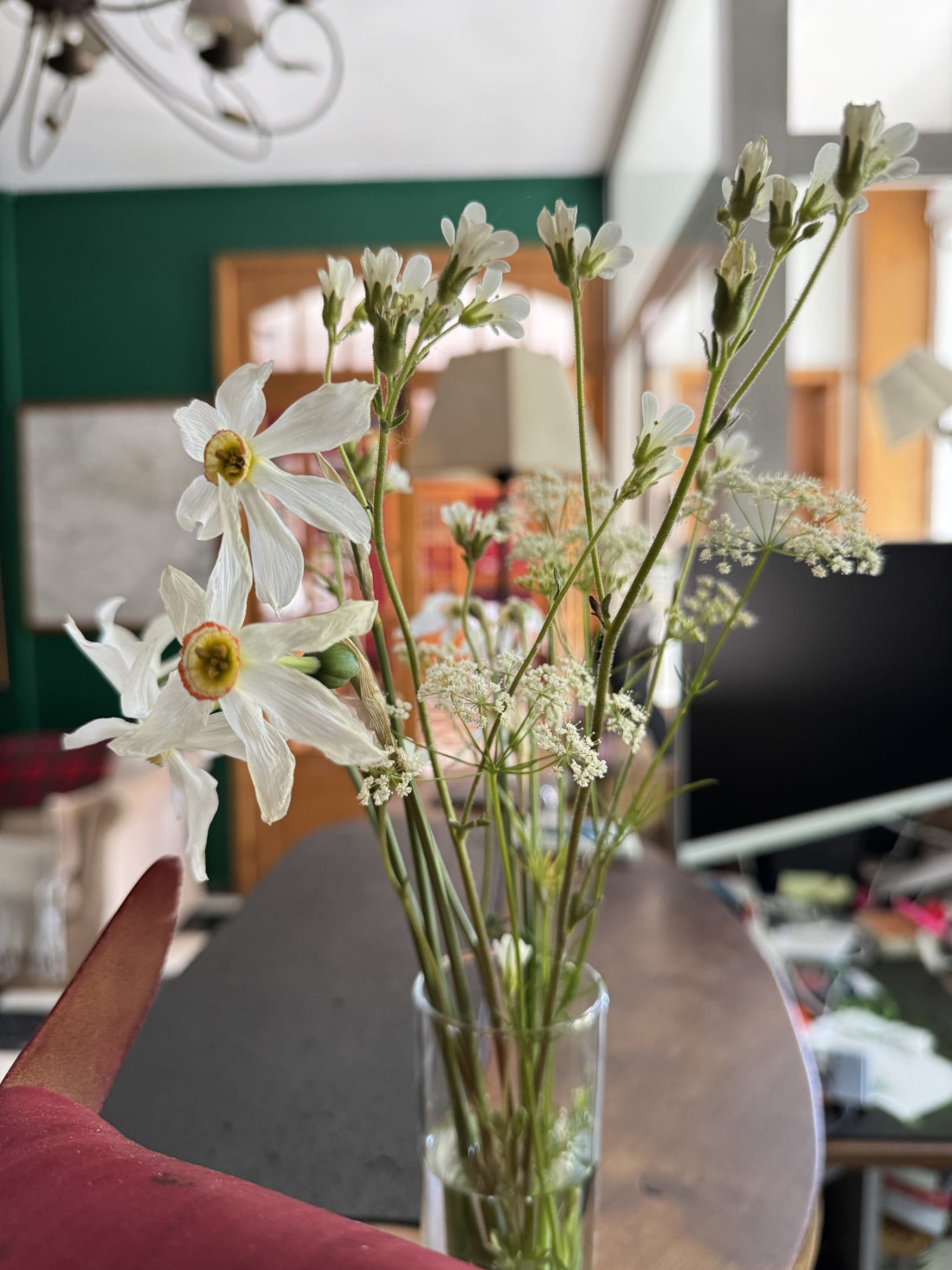
That scent doesn't actually stay with us: some of it travels all the way to Grasse, the capital of perfume, where it serves as a raw material for the perfumers. The harvest demands extreme delicacy, for all the aroma lies in the flower itself: only the corolla is picked, leaving the stem and leaves in place, which allows the plant to return the following year.
And all the rest
The Aubrac isn't just its two stars. Along the walks, you come across pasque flowers with their downy violet petals, shyer wood anemones, or wild orchids standing in little pink spikes. The richness is such that a single meadow can shelter dozens of different species side by side — and it's precisely these countless plant flavours that the cows later transform into the very particular taste of the cheeses from here.
A little herbarium card
Daffodil — golden yellow, from April, in the meadows of the northern plateau.
Poet's narcissus — white with a yellow heart, peaking in May, more or less everywhere on the summer pastures.
Pasque flower — downy violet, early spring, on the dry slopes.
Pyramidal orchid — pink in a spike, late spring, at the meadow's edge.
Spring as an experience
What I love most is everything my guests discover from the house without even having to walk. In the morning, the mist that lifts slowly above the pastures and reveals the dry-stone walls one by one. In the evening, that low, new light that sets the granite aglow. And between the two, that immense, barely disturbed silence that makes the plateau one of the rare places where you can hear yourself breathe.

And then there are the walks. For the first daffodils, I often suggest a short loop with no cruel climb — just enough to step into the flowering meadows. For those who want to walk more, the paths stretch out toward the streams, the summer pastures and all that small heritage that makes the soul of the plateau: lone crosses, squat burons, chapels around the bend of a meadow. Many of these trails follow the drailles, the old stone paths that once linked the valley to the heights and that the herds still use today. Most are lined with dry-stone walls, raised over the centuries as the plots were cleared of their stones.
Walk there in spring and all your senses wake at once: the smell of wet grass, the murmur of streams swollen by the meltwater, the birdsong that no longer stops, and underfoot, at every metre, a new flower.
Local life to the rhythm of the seasons
Spring here is not just scenery. It's a season of work, of movement, of tradition. Above all, it's the moment when the animals go back up. From May to October, the plateau comes alive again: the burons reopen, men and herds climb to the heights, and the mountain comes back to life.
The transhumance is the season's great event. The herds still cross the villages to the sound of bells, then set off along the drailles before reaching the high pastures. And what a sight: around 25 May, thousands of cows decked with flowers and pompoms make their way up to the summer pastures, followed by a crowd that comes from everywhere. This year, the festivities ran over several days, usually the last weekend of May, with the great climb of the herds on the Sunday.
Meanwhile, in the meadows, another ballet unfolds: that of the narcissus pickers, bent over the flowers for hours, filling their bags with that scent promised to Grasse. Two simultaneous movements — the animals climbing, the flowers being gathered — that tell, at heart, the same thing: the plateau is very much alive.
On the plate, the taste of spring
All this inevitably ends up on the table. Spring is the return of the fresh and the light after winter's dishes: the first wild herbs, the young vegetables, and of course the cheeses of the plateau — the very ones that have kept, deep in their paste, the memory of the thousand flowers grazed on the summer pastures.
I like to compose my seasonal menus the way you'd arrange a bouquet: looking for the colours, the lightness, sometimes an edible flower set on the plate to recall what grows a few metres away. A herb soup, a fresh cheese drizzled with a thread of Aubrac honey, a few shoots picked that very morning — that's all it takes to have the whole of spring on the plate.
Coming to enjoy the bloom: a few tips
If the urge takes you to come and see all this, here's what I'd tell a friend.
First, choose your moment according to what you want to see. The daffodils are best seen in April; the great sheets of narcissi, rather in May. But bear in mind that nature decides alone, and that no spring is ever quite like the last.
Next, pack something warm. We're at altitude, the weather turns quickly, and a late snowfall is nothing unusual. Even in May, slip a jumper and a windbreaker into your bag.
Finally, walk as a guest, not as an owner. Stay on the paths, don't trample the flowering meadows, and if you pick a narcissus, make do with one or two. Picking is part of the customs here, but it's done with restraint, sparing the fragile areas. And don't forget that the pastures are the farmers' livelihood: a herd is something you go around, not through.
Come and live your own spring
At heart, what I love about this season is that it's like nothing else. It's a fresh start. An energy that returns, the urge to go out, to walk, to breathe deeply, to take up writing again or simply to look. Spring in the Aubrac is all of that at once — fragile, brief, dazzling.
If your heart tells you to, come and live it for real: book a few days at the house, in the flowering season that appeals to you most.
The plateau awaits you. The flowers wait for no one — and that's exactly why you should come.
You might also enjoy :
What to Do in the Aubrac in Summer? 10 Family Experiences Not to Miss
The Secret Winter of the Aubrac: Stories, Paths and Little Secrets of the Plateau
Where to Stay in the Aubrac? An Honest Guide from a Family Who's Lived Here Since 1870


